


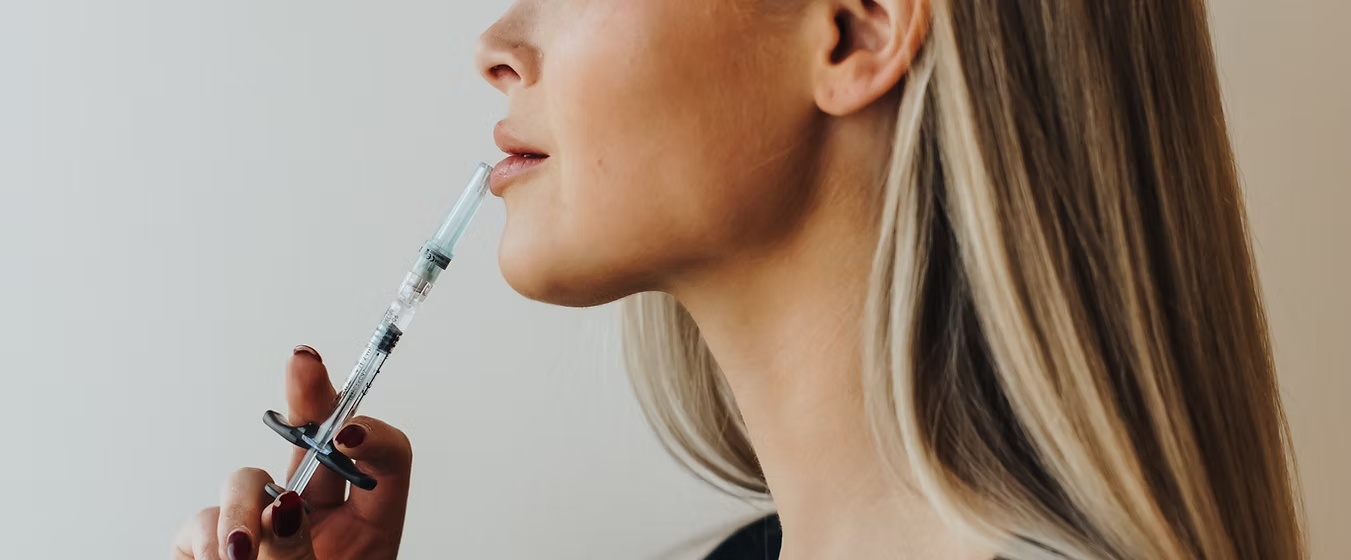
Sculptra treatments generate $450 million annually yet 64% of patients abandon therapy after initial sessions due to unrealistic expectations about gradual collagen building, with providers failing to explain why results take 3-6 months to develop or why massage protocols determine success versus nodule formation affecting 15% of improperly treated patients. This guide reveals exactly how Sculptra stimulates natural collagen production, the scientific rationale behind multiple session protocols, and the critical massage techniques that distinguish smooth results from lumpy disasters—helping Edmonton patients understand whether this gradual approach aligns with their aesthetic goals and patience levels.
Table of Contents:
- The Problem: Why Sculptra Expectations Lead to Treatment Abandonment
- What to Consider: Collagen Mechanisms, Treatment Protocols, and Result Timeline
- How to Choose: Patient Selection and Maintenance Planning
- Marlee Patricia Aesthetics’ Sculptra Excellence Protocol
- Frequently Asked Questions
The Problem: Why Sculptra Expectations Lead to Treatment Abandonment
The Instant Gratification Disconnect
Modern aesthetic patients conditioned by immediate hyaluronic acid filler results struggle accepting Sculptra’s 3-6 month collagen building timeline, with 71% expressing disappointment when leaving initial appointments looking identical to arrival despite paying $800-$1,200 per vial. The disconnect between investment and visible improvement creates doubt about treatment efficacy, leading patients to abandon protocols before collagen stimulation manifests.
The biological reality of collagen synthesis cannot be accelerated regardless of patient urgency or provider promises. Poly-L-lactic acid (PLLA) particles require weeks to trigger fibroblast activation. Collagen production begins at 4-6 weeks post-injection but remains microscopically invisible. Visible tissue thickening emerges around month two. Peak improvement develops at 4-6 months. This gradual progression follows immutable cellular processes that marketing conveniently minimizes when promoting treatment.
Patient behavior during the waiting period undermines optimal outcomes:
- Constant face checking for non-existent immediate changes
- Comparison to immediate filler results in friends
- Doubt about provider competence when changes don’t appear
- Requests for hyaluronic acid filler to bridge the gap
- Abandonment before completing recommended sessions
The financial psychology proves particularly challenging when patients invest thousands in treatments showing no immediate return. Initial sessions of 2-4 vials costing $1,600-$3,200 provide subtle foundation that subsequent treatments build upon. However, without visible improvement, patients question continuing investment. The collagen production science demonstrates that premature discontinuation wastes initial investment while preventing achievement of desired outcomes.
Marketing materials showing dramatic before-after photos fail to disclose the 6-month timeline and multiple sessions required. Providers eager to sell treatment may minimize the patience required. Social media transformation posts never mention the months of waiting or number of vials used. This information asymmetry creates expectations that biology cannot meet, ensuring disappointment regardless of technical success.
The Nodule Formation Fear
Horror stories about Sculptra nodules—occurring in 7-15% of treatments when proper technique isn’t followed—create anxiety that prevents patients from pursuing treatment or following critical massage protocols that actually prevent the complications they fear. The reputation damage from early 2000s nodule cases persists despite technique improvements reducing incidence to under 1% with proper protocols.
Nodule formation results from preventable technical errors rather than inherent product issues:
- Insufficient dilution creating concentrated PLLA deposits
- Superficial injection allowing palpable particles
- Large bolus injection rather than distributed placement
- Inadequate mixing leaving particle clumps
- Poor patient selection with thin skin
- Failure to follow massage protocols
The cascade of nodule development begins with improper injection technique. Concentrated PLLA particles trigger excessive localized inflammation. Fibroblasts encapsulate particle clusters creating firm nodules. Continued collagen deposition enlarges nodules over months. Once established, nodules persist for 12-18 months until PLLA degrades. Treatment requires intralesional steroids or surgical excision in severe cases.
Modern injection protocols virtually eliminate nodule risk through specific techniques:
- Dilution to 8-9ml providing proper particle distribution
- Deep supraperiosteal placement avoiding superficial planes
- Multiple small aliquots preventing concentration
- Cross-hatch or fanning patterns ensuring even spread
- 24-48 hour reconstitution allowing complete hydration
- Patient education ensuring massage compliance
The injection safety guidelines emphasize that provider experience correlates directly with complication rates. Inexperienced injectors following outdated protocols perpetuate nodule formation that experienced providers avoid through proper technique.
The Volume Calculation Confusion
Sculptra’s mechanism of gradual collagen stimulation makes volume prediction nearly impossible, yet providers quote specific vial numbers without explaining the 30-50% variation in individual collagen response that determines whether 4 vials or 8 vials achieve desired correction. This uncertainty creates budget anxiety and treatment planning challenges that hyaluronic acid fillers avoid through predictable volume replacement.
Individual collagen response varies based on multiple factors providers cannot precisely predict:
- Age: Younger patients generate more collagen per vial
- Genetics: Collagen synthesis capacity varies 3-fold
- Lifestyle: Smoking reduces response by 40%
- Metabolism: Athletic patients may generate less collagen
- Skin quality: Sun damage impairs fibroblast function
- Treatment area: Mobile areas produce less collagen
The standard recommendation of “1 vial per decade of age” for full face correction provides starting guidance but proves inadequate for individual planning. A 40-year-old athlete may need 6 vials while a sedentary peer achieves better results from 3 vials. This variation makes cost estimation difficult, with total treatment ranging from $2,400-$7,200 for similar outcomes.
Providers attempting to guarantee specific results from predetermined vial numbers either lack experience or prioritize sales over honesty. The ethical approach acknowledges uncertainty, starting conservatively and building based on individual response. However, this honesty may lose patients to competitors making unrealistic promises. The tension between truthful communication and business pressure perpetuates misinformation.
The Maintenance Mystery
Unlike hyaluronic acid fillers with predictable 6-18 month duration, Sculptra’s longevity claims of “up to 2 years” obscure the reality that collagen degradation varies dramatically between patients, with some maintaining results for 3+ years while others show deterioration at 12 months. This uncertainty complicates maintenance planning and budget allocation.
The degradation timeline follows complex patterns influenced by ongoing aging:
- Months 0-6: Progressive collagen building
- Months 6-12: Plateau at peak correction
- Months 12-24: Gradual collagen degradation
- Months 24-36: Return toward baseline
- Beyond 36 months: Variable persistence
Natural aging continues during Sculptra’s effect, meaning patients never truly return to baseline. The stimulated collagen degrades while natural collagen loss accelerates with age. This dual process makes assessing true duration challenging. Some patients maintain improvement for years through ongoing natural collagen remodeling. Others experience rapid degradation requiring annual maintenance.
Maintenance strategies remain poorly defined compared to filler protocols:
- Annual single vial “boost” maintaining stimulation
- Complete re-treatment cycles every 2-3 years
- Alternating Sculptra with HA fillers
- Combination approaches unclear optimal timing
- Individual variation preventing standardization
The aging skin studies indicate that repeated Sculptra treatments may create cumulative improvement through sustained fibroblast activation, though long-term data remains limited.
What to Consider: Collagen Mechanisms, Treatment Protocols, and Result Timeline
Understanding Collagen Stimulation
Sculptra’s poly-L-lactic acid particles work through complex biological mechanisms that distinguish biostimulators from simple volume replacement, requiring patient understanding for realistic expectations and treatment compliance.
1. The Biological Cascade: PLLA particles injected into deep tissue planes trigger immediate inflammatory response as the body recognizes foreign material. Macrophages attempt to digest particles but cannot break down the polymer structure. This sustained interaction recruits fibroblasts to encapsulate particles. Activated fibroblasts produce Type I collagen—the structural protein providing skin firmness. Collagen deposition continues for 3-6 months until particles fully degrade.
The collagen production timeline explains delayed results:
- Weeks 1-2: Initial inflammation and cellular recruitment
- Weeks 3-4: Early fibroblast activation beginning synthesis
- Weeks 5-8: Microscopic collagen deposition invisible clinically
- Weeks 9-12: Tissue thickening becoming palpable
- Months 3-4: Visible improvement emerging
- Months 5-6: Peak collagen production achieved
This gradual process cannot be accelerated through higher doses or more frequent treatments. Attempting to speed results through excessive product creates nodules rather than faster improvement. The collagen production science confirms that respecting biological timing ensures optimal outcomes while preventing complications.
2. Quality Versus Quantity: Sculptra stimulates organized collagen production creating natural tissue architecture rather than simple volume. The newly formed collagen integrates with existing structures, improving skin quality beyond mere inflation. This explains why Sculptra results appear more natural than some fillers—the improvement comes from within rather than external addition.
Collagen characteristics from Sculptra stimulation:
- Type I collagen identical to natural production
- Organized fiber arrangement providing structure
- Integration with existing collagen networks
- Improved skin thickness and elasticity
- Enhanced light reflection from dermal quality
- Gradual remodeling maintaining natural appearance
3. Limitations of Stimulation: Not all patients respond equally to biostimulation, with some generating minimal collagen despite proper treatment. Factors limiting response include advanced age with senescent fibroblasts, extensive sun damage impairing cellular function, smoking inhibiting collagen synthesis, certain medications affecting healing, autoimmune conditions disrupting normal response, and genetic variations in collagen production capacity.
Treatment Session Protocols
The multi-session approach to Sculptra treatment follows scientific rationale based on collagen synthesis patterns and safety considerations rather than arbitrary provider preferences or revenue generation.
1. The Standard Three-Session Protocol: Traditional Sculptra treatment involves three sessions spaced 4-6 weeks apart, allowing assessment of individual response while building correction gradually. This spacing permits initial inflammation resolution before subsequent treatment. Collagen production from session one continues during sessions two and three, creating layered improvement. The gradual building prevents overcorrection while enabling adjustment based on emerging results.
Session distribution typically follows:
- Session 1: Foundation building with 2-3 vials addressing primary volume loss
- Session 2: Refinement adding 1-2 vials based on initial response
- Session 3: Final adjustment with 1-2 vials achieving desired correction
This protocol totals 4-7 vials for moderate correction, with severe volume loss requiring additional sessions. The gradual approach costs more through multiple appointments but prevents complications from aggressive treatment while allowing customization impossible with single sessions.
2. Alternative Protocol Variations: Modern approaches adapt traditional protocols based on patient factors and goals. Younger patients with minimal volume loss may achieve goals in two sessions. Older patients with severe atrophy might need 4-5 sessions. Athletic patients requesting subtle improvement benefit from lower doses over more sessions. Budget constraints may necessitate spreading treatments over 6 months.
Modified protocols gaining acceptance:
- “Low and slow”: 1 vial monthly for 4-6 months
- “Loading dose”: 3-4 vials initially then maintenance
- “Annual touch-up”: 1-2 vials yearly after initial series
- “Combination protocol”: Alternating with HA fillers
- “Targeted approach”: Focusing on specific areas sequentially
The facial anatomy research supports individualized protocols based on assessment rather than rigid adherence to standard approaches.
3. Reconstitution and Preparation: Proper Sculptra reconstitution critically affects both results and safety, with inadequate preparation causing most complications. Standard reconstitution uses 7-9ml sterile water for injection, though some providers add lidocaine for comfort. Reconstitution must occur 24-48 hours before treatment allowing complete hydration. Immediate use of inadequately hydrated product creates particle clumps causing nodules.
Critical preparation steps:
- Add dilution water slowly to prevent foaming
- Gentle swirling rather than vigorous shaking
- Multiple inversions ensuring complete mixing
- Standing time allowing full hydration
- Re-agitation immediately before drawing
- Consistent mixing throughout treatment session
Dilution volume affects treatment characteristics. Higher dilution (9ml) provides easier flow and wider distribution but requires more injection volume. Lower dilution (7ml) allows precise placement but increases nodule risk if technique falters. Provider experience determines optimal dilution for specific applications.
The 5-5-5 Massage Rule
Post-treatment massage represents the critical difference between smooth results and nodule formation, yet patient compliance remains poor due to inadequate education about technique importance.
1. Understanding the 5-5-5 Protocol: The massage rule requires 5 minutes of massage, 5 times daily, for 5 days following treatment. This totals 125 minutes of massage ensuring even PLLA particle distribution before encapsulation begins. The mechanical manipulation prevents particle clustering while promoting even spread through tissue planes. Starting immediately post-treatment when particles remain mobile proves most effective.
Proper massage technique involves:
- Firm circular motions covering entire treatment area
- Pressure sufficient to feel deep tissue without pain
- Overlapping circles ensuring complete coverage
- Direction changes preventing pattern formation
- Consistent pressure avoiding aggressive manipulation
The timing of massage sessions matters equally to duration. Spacing throughout the day maintains particle suspension. Morning massage addresses overnight settling. Evening massage prevents accumulation during sleep. Midday sessions maintain distribution during daily activities. This temporal distribution optimizes particle spread beyond what concentrated massage achieves.
2. Why Patients Fail to Comply: Despite clear instructions, studies show only 40% of patients complete prescribed massage protocols. Common reasons include forgetting amid daily activities, uncertainty about proper technique, fear of displacing product, discomfort from tender treatment areas, embarrassment performing massage publicly, and skepticism about necessity given absent immediate results.
Strategies improving compliance:
- Written instructions with diagram illustrations
- Video demonstration accessible via phone
- Timer apps providing massage reminders
- Partner involvement for accountability
- Follow-up calls checking compliance
- Emphasis on nodule prevention motivation
3. Long-Term Tissue Remodeling: Beyond immediate particle distribution, massage may influence long-term collagen organization through mechanical stimulation. Regular facial massage during the collagen building phase potentially enhances results through improved circulation, lymphatic drainage, and fibroblast activation. Though not scientifically proven, many providers recommend continued gentle massage throughout the treatment period.
The injection safety guidelines classify post-treatment massage as essential for optimal outcomes rather than optional enhancement.
Result Development Timeline
Understanding realistic result progression prevents premature disappointment while enabling recognition of optimal outcomes versus need for additional treatment.
1. Immediate Post-Treatment Phase (Days 1-14): Immediately following injection, temporary swelling from dilution volume creates fullness disappearing within 24-72 hours. This immediate improvement generates false expectations when patients see instant enhancement that vanishes. The deflation to baseline or worse appearance at one week causes significant distress. Providers must emphasize this temporary effect to prevent panic.
The two-week period involves:
- Initial swelling resolution by day 3
- Complete return to baseline by day 7
- Possible bruising lasting 7-10 days
- Tenderness with massage gradually improving
- No visible improvement despite investment
- Psychological adjustment to waiting
Patient support during this period proves critical for treatment continuation. Photos documenting baseline appearance provide objective comparison. Explanation of ongoing cellular activity despite absent visible changes maintains confidence. Scheduling next session provides forward momentum despite current disappointment.
2. Early Building Phase (Weeks 3-8): Microscopic collagen production begins around week 3 but remains clinically invisible for several more weeks. Patients may perceive subtle skin quality improvements—better hydration, improved texture, or enhanced glow—before volumetric changes appear. These early signs indicate treatment response though dramatic improvement remains months away.
Observations during early building:
- Skin feeling thicker or firmer to touch
- Improved makeup application and wear
- Subtle softening of fine lines
- Better light reflection from skin
- Partner comments about looking “rested”
- Gradual rather than sudden changes
This phase requires patience as improvement remains subtle relative to investment. Providers should schedule check-ins maintaining engagement. Photos may show minimal change discouraging patients. Focus on skin quality improvements maintains motivation for continuing treatment.
3. Visible Improvement Phase (Months 2-4): Meaningful volumetric improvement emerges around month 2-3 as collagen accumulation reaches visible threshold. The change appears gradually—patients often don’t notice until comparing photos. Friends comment on looking refreshed without identifying specific changes. This natural progression distinguishes Sculptra from obvious filler transformation.
Progressive improvements include:
- Facial contours becoming more defined
- Hollow areas developing subtle fullness
- Skin appearing thicker and healthier
- Wrinkles softening from dermal support
- Overall refreshed appearance emerging
- Confidence increasing with visible results
Documentation during this phase guides decisions about additional treatment. Some patients achieve goals from initial series while others need supplementation. The individual variation in collagen response becomes apparent. Adjustment of remaining sessions optimizes outcomes based on observed response.
4. Peak Results Phase (Months 4-6): Maximum improvement typically manifests 4-6 months post-final treatment as collagen production peaks. The full correction reveals whether treatment goals were achieved or additional sessions prove necessary. This extended timeline means patients completing treatment in January see final results in June—requiring significant patience and faith.
Peak results characteristics:
- Natural volume restoration without appearing “filled”
- Improved facial contours and definition
- Enhanced skin quality and thickness
- Softened wrinkles and folds
- Refreshed appearance maintaining individual character
- Results appearing intrinsic rather than added
The aging skin studies confirm that peak results from Sculptra often exceed patient expectations due to comprehensive tissue improvement beyond simple volume addition.
How to Choose: Patient Selection and Maintenance Planning
Ideal Candidate Identification
Successful Sculptra treatment requires careful patient selection based on anatomical factors, psychological readiness, and lifestyle compatibility rather than treating everyone seeking facial rejuvenation.
1. Anatomical Considerations: Optimal candidates demonstrate specific physical characteristics predicting good response. Moderate facial volume loss responds better than severe atrophy requiring excessive product. Adequate skin thickness conceals particles preventing visibility. Good skin quality with remaining elasticity accommodates new collagen effectively. Areas of dynamic movement may respond less favorably than static regions.
Physical factors favoring Sculptra:
- Temple hollowing from fat pad atrophy
- Cheek volume loss creating flat midface
- Generalized facial thinning from aging
- HIV-associated lipoatrophy (original indication)
- Desire for global improvement versus spot treatment
- Realistic expectations about gradual enhancement
Contraindications requiring alternative treatments:
- Severe skin laxity needing surgical intervention
- Isolated concerns better addressed with HA filler
- Very thin skin risking visible particles
- Unrealistic expectations about transformation degree
- Impatience requiring immediate results
- History of poor wound healing or keloids
2. Psychological Readiness Assessment: The delayed gratification inherent to Sculptra demands psychological preparation many patients lack. Understanding that results take months prevents abandonment. Accepting gradual change rather than dramatic transformation ensures satisfaction. Committing to multiple sessions and massage protocols indicates readiness. Financial preparation for uncertain total vials demonstrates planning.
Questions revealing psychological readiness:
- Can you wait 4-6 months for results?
- Will you complete massage protocols diligently?
- Do you understand gradual versus immediate change?
- Can you afford potentially 6-8 vials total?
- Will you maintain realistic expectations?
- Are you seeking natural or dramatic enhancement?
Patients conditioned by immediate filler results often struggle with Sculptra’s timeline. Those who research thoroughly and understand the mechanism typically achieve better outcomes through appropriate expectations. Providers should screen for patience and commitment rather than accepting all interested patients.
3. Lifestyle Compatibility Factors: Certain lifestyle factors affect both treatment response and maintenance requirements. Athletes with high metabolic rates may generate less collagen requiring more product. Smokers show 40% reduced response necessitating adjusted expectations. Sun exposure accelerates collagen degradation shortening longevity. Stress affects healing and collagen synthesis. These factors influence both patient selection and treatment planning.
The skin health fundamentals emphasize that successful biostimulator treatment requires holistic consideration of patient factors beyond simple anatomical assessment.
Treatment Planning Strategy
Comprehensive treatment planning for Sculptra must account for individual variables, gradual building approach, and integration with other aesthetic treatments.
1. Initial Consultation Framework: Thorough consultation establishes realistic goals while identifying factors affecting treatment response. Global facial assessment reveals volume loss patterns guiding product distribution. Medical history identifies conditions or medications affecting collagen synthesis. Previous treatment experience indicates preferences and response patterns. Budget discussion ensures financial preparation for complete treatment series.
Essential consultation elements:
- Standardized photography from multiple angles
- Volume assessment using facial scales
- Skin quality evaluation for candidacy
- Discussion of timeline and patience required
- Written estimate for likely vial requirements
- Clear explanation of gradual results
Setting appropriate expectations prevents dissatisfaction despite technical success. Visual aids showing typical progression help patients understand the journey. Before-after photos must indicate timeframes and vial numbers. Honest discussion about individual variation prevents disappointment if results differ from examples.
2. Vial Calculation Methods: While precise vial requirements remain unpredictable, general guidelines provide starting estimates. The “vial per decade” rule suggests 40-year-olds need 4 vials total. Facial volume scales correlating deficit to vial numbers offer more precision. Starting conservatively with reassessment allows adjustment. Building gradually prevents overcorrection while optimizing individual response.
Factors affecting vial requirements:
- Baseline volume deficit severity
- Individual collagen response capacity
- Treatment area size and number
- Desired correction degree
- Age and skin quality
- Previous treatments affecting tissue
Most patients require 4-8 vials total for meaningful improvement, though range spans 2-12 vials. Starting with 4-6 vials over three sessions provides foundation for assessment. Additional vials address remaining concerns if needed. This staged approach prevents overcorrection while managing costs.
3. Integration with Other Treatments: Sculptra rarely serves as sole treatment for facial rejuvenation, with strategic combination of modalities addressing different aging aspects. Neuromodulators relax dynamic wrinkles unaffected by volume. HA fillers provide immediate correction while awaiting Sculptra results. Skin resurfacing improves texture and pigmentation. Energy devices tighten lax tissue. Coordinating treatments optimizes outcomes while preventing interference.
Timing considerations for combinations:
- Neuromodulators 2 weeks before or after Sculptra
- HA fillers after Sculptra series completion
- Resurfacing procedures between Sculptra sessions
- Energy devices avoiding treatment areas for 3 months
- Surgical procedures before or 6+ months after
Maintenance Protocol Development
Establishing sustainable maintenance strategies ensures long-term results while preventing the deterioration requiring complete re-treatment.
1. Longevity Assessment Methods: Determining individual Sculptra duration guides maintenance planning though variability complicates standardization. Serial photography at 6-month intervals tracks gradual changes. Patient perception of volume loss indicates subjective deterioration. Objective measurements using facial scales quantify changes. Comparison to baseline rather than peak prevents premature re-treatment.
Duration typically follows patterns:
- 6-12 months: Continued improvement or plateau
- 12-18 months: Stable maintenance of correction
- 18-24 months: Gradual volume decrease beginning
- 24-30 months: Noticeable deterioration
- 30-36 months: Return toward baseline
Individual variation spans 12-48 months making personalized tracking essential. Some maintain improvement for years while others need annual touch-ups. Recording response patterns enables predictive planning for future treatments.
2. Touch-Up Versus Re-Treatment: Maintenance strategies vary from annual single-vial touch-ups to complete re-treatment cycles every 2-3 years. Touch-ups maintaining stimulation prove more economical than allowing complete deterioration. Single vials annually may sustain results indefinitely in good responders. Poor responders need 2-3 vials yearly or complete cycles. Finding individual maintenance requirements takes time and documentation.
Touch-up protocols being evaluated:
- Annual 1-2 vials maintaining collagen stimulation
- Bi-annual treatments with alternating Sculptra/HA filler
- Every 18 months with 2-3 vials
- Complete re-treatment at 24-30 months
- Combination approaches based on areas
The collagen production science suggests that repeated stimulation may create cumulative improvement reducing future requirements, though long-term data remains limited.
Cost Planning Considerations: Long-term Sculptra maintenance requires financial planning beyond initial investment. Initial series costing $3,200-6,400 represents entry cost. Annual maintenance adds $800-2,400 ongoing. Complete re-treatment every 2-3 years costs similar to initial series. These expenses must be weighed against alternative maintenance options.
Comparing maintenance costs:
- Sculptra touch-ups: $800-2,400 annually
- HA filler maintenance: $2,000-4,000 annually
- Surgical intervention: $15,000-25,000 per decade
- Combined approaches: Variable based on protocols
- No treatment: Accelerated aging appearance
Marlee Patricia Aesthetics’ Sculptra Excellence Protocol
Advanced Injection Technique
Marlee Patricia Aesthetics employs refined Sculptra injection techniques developed through extensive training and experience, ensuring optimal collagen stimulation while preventing complications that plague inexperienced providers.
The injection approach begins with proper reconstitution 48 hours before treatment, allowing complete particle hydration that prevents nodule formation. Marlee uses 8-9ml dilution providing ideal flow characteristics while maintaining appropriate concentration. The extended reconstitution time ensures uniform suspension critical for even distribution. This preparation attention distinguishes quality treatment from rushed approaches risking complications.
Anatomical expertise guides precise placement in appropriate tissue planes. Deep supraperiosteal injection provides stable positioning while avoiding superficial visibility. Understanding facial fat compartments enables targeted treatment addressing specific aging patterns. Recognition of vascular anatomy prevents dangerous intravascular injection. This anatomical knowledge accumulated through years of nursing experience ensures both safety and efficacy.
The injection technique employs multiple approaches based on treatment areas:
- Cross-hatching in temples for even distribution
- Fanning pattern in cheeks for broad coverage
- Threading along jawline for definition
- Depot injections in specific hollow areas
- Combination techniques adapting to anatomy
Post-injection massage immediately following treatment ensures initial particle distribution before patients leave. This professional massage demonstrates proper technique while providing initial dispersion. Patients receive hands-on instruction ensuring home massage effectiveness. This education investment reduces nodule risk while optimizing results.
Patient Education Excellence
Comprehensive patient education distinguishes Marlee Patricia Aesthetics’ approach, ensuring realistic expectations and protocol compliance that determine treatment success.
The education process begins during consultation with detailed explanation of collagen stimulation mechanisms. Visual aids including microscopic images demonstrate how PLLA particles trigger fibroblast activation. Timeline graphics show realistic result progression over months. This scientific education helps patients understand and accept the gradual process rather than expecting immediate transformation.
Written materials reinforce verbal education ensuring retention:
- Illustrated massage instructions with anatomical landmarks
- Timeline calendars marking expected progression
- Warning signs requiring contact
- Lifestyle modifications optimizing results
- Maintenance recommendations based on response
Video resources accessible via smartphone provide ongoing support. Massage demonstration videos ensure proper technique between visits. Timeline videos show typical progression maintaining patience. FAQ videos address common concerns. This multimedia approach accommodates different learning styles while providing reference throughout treatment.
Follow-up communication maintains engagement during the waiting period. Check-in calls at one week confirm massage compliance. Progress assessments at one month maintain confidence. Photo reviews at three months document emerging changes. This ongoing support prevents abandonment while optimizing outcomes through sustained engagement.
Results Optimization Protocol
Marlee’s systematic approach to results optimization ensures each patient achieves their best possible outcome through careful monitoring and adjustment based on individual response patterns.
Treatment documentation enables evidence-based optimization across sessions. Standardized photography captures subtle changes invisible to memory. Injection maps record product placement guiding subsequent sessions. Response notes track individual collagen generation patterns. This data accumulates into personalized treatment profiles improving outcomes.
The building strategy adapts based on emerging response:
- Conservative initial treatment establishing baseline
- Four-week assessment guiding second session
- Adjustment of vial numbers based on response
- Area-specific refinement in later sessions
- Final perfection achieving balanced results
Combination strategies enhance Sculptra results when indicated. Strategic HA filler placement provides immediate correction while awaiting collagen development. Neuromodulators reduce dynamic wrinkles unaffected by volume. Skin quality treatments improve texture complementing volume restoration. This integrated approach achieves comprehensive rejuvenation exceeding isolated treatments.
The facial anatomy research confirms that systematic optimization based on individual response patterns produces superior outcomes compared to standardized protocols.
Long-Term Partnership Approach
Marlee Patricia Aesthetics views Sculptra treatment as an ongoing partnership optimizing results through careful monitoring and maintenance rather than isolated treatment series.
The relationship building begins with honest communication about realistic outcomes and timeline. Marlee’s nursing background enables medical precision while maintaining approachable demeanor. Trust develops through transparent discussion of uncertainties inherent to biostimulation. This honesty may sacrifice quick sales but ensures long-term satisfaction and relationship.
Regular monitoring throughout the collagen building phase maintains engagement:
- Month 1: Massage compliance verification
- Month 2: Early response assessment
- Month 3: Progress documentation
- Month 4: Near-peak evaluation
- Month 6: Final results assessment
- Ongoing: Annual maintenance planning
This structured follow-up ensures optimal outcomes while building lasting relationships. Patients appreciate the attention extending beyond treatment sessions. Problems receive early intervention preventing complications. Success gets documented for reference. This investment in relationships generates referrals from satisfied patients.
Maintenance planning based on individual patterns ensures sustained results. Recording duration patterns enables predictive scheduling. Budgeting assistance helps plan for ongoing treatments. Integration with other aesthetic treatments maintains comprehensive approach. This long-term perspective distinguishes medical aesthetics from transactional cosmetic services.
Frequently Asked Questions
1. How many Sculptra vials will I actually need for good results?
Most patients require 4-8 vials total for meaningful facial rejuvenation, though individual needs vary from 2-12 vials based on baseline volume loss, age, and collagen response capacity that cannot be precisely predicted before treatment begins. The traditional “one vial per decade of age” provides rough estimation—a 50-year-old might need 5 vials—but factors like skin quality, lifestyle, and genetics create 50% variation from this average. Starting with 4-6 vials over three sessions allows response assessment before committing to additional product, preventing both under-treatment and excessive cost. The collagen production science demonstrates that gradual building based on individual response produces better outcomes than predetermined vial numbers.
2. Why does Sculptra take so long to show results?
Sculptra works by stimulating your body’s natural collagen production rather than simply adding volume, requiring 3-6 months for visible results because collagen synthesis follows biological timelines that cannot be accelerated regardless of dose or technique. The poly-L-lactic acid particles must first trigger inflammatory response (weeks 1-2), recruit fibroblasts (weeks 3-4), initiate collagen production (weeks 5-8), achieve sufficient accumulation (months 2-3), and reach peak synthesis (months 4-6). This gradual process produces natural-looking results that last 2+ years versus immediate but shorter-lasting HA filler results. Understanding this mechanism helps maintain patience during the waiting period when no visible changes occur despite significant investment.
3. What happens if I don't massage after Sculptra treatment?
Failing to follow the 5-5-5 massage protocol (5 minutes, 5 times daily, for 5 days) significantly increases risk of nodule formation from 1% to 10-15% as PLLA particles cluster rather than distributing evenly through tissue planes. Without massage, particles accumulate in concentrated deposits triggering excessive localized inflammation and collagen production creating palpable or visible lumps lasting 12-18 months until natural degradation. These nodules may require steroid injections, surgical removal, or waiting for spontaneous resolution—all preventable through proper massage. The injection safety guidelines classify post-treatment massage as essential rather than optional, with providers potentially liable for complications from inadequate patient education.
4. Can I get hyaluronic acid filler while doing Sculptra treatments?
Combining HA filler with Sculptra requires strategic timing to avoid interference while optimizing results, with most providers recommending completing the initial Sculptra series before adding HA filler for refinement. During active Sculptra treatment, avoid HA filler in the same areas for 4-6 weeks between sessions allowing accurate assessment of collagen response. After completing Sculptra series, HA filler can address remaining concerns like lips or tear troughs that Sculptra doesn’t treat well. Some providers alternate Sculptra and HA filler every 3-4 months for comprehensive maintenance. The aging skin studies suggest combination approaches may provide superior long-term outcomes through complementary mechanisms.
5. How do I know if Sculptra is working if I can't see results for months?
Early indicators of Sculptra response appear before visible volume improvement, including subtle skin quality changes at 4-6 weeks like improved texture and hydration, clothes fitting differently around the face, makeup applying more smoothly, partners commenting you look “rested” without identifying specific changes, and photographs showing gradual improvement though imperceptible day-to-day. The absence of immediate visible results doesn’t indicate treatment failure—cellular activity proceeds regardless of clinical appearance. Patience during months 1-3 proves essential, with most patients experiencing “sudden” improvement around month 3-4 when collagen accumulation reaches visible threshold. Providers should schedule progress checks with photos documenting subtle changes maintaining confidence during the building phase.